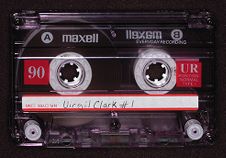
Interview with Virgil S. Clark


[This text is machine generated and may contain errors.]


Interviewer: LeAnne Johnson
Interviewee: Virgil Clark
2001

LJ: 0:00
All right now to start the interview, just want you to state your name where you were born.

VC: 0:06
I'm Virgil Clark. I was born in Greenville, North Carolina on April 3rd of 1925.

LJ: 0:12
Okay. And what was it like living in Greenville?

VC: 0:16
It was quiet and peaceful and no traffic, it was fine, it was just a sleepy town, mostly serving the farmers in the area. They had very, very little industry. Most [unintelligible] revolved around the farming.

LJ: 0:32
That's interesting, did you live in town, or did you live on a farm?

VC: 0:38
No, I lived in town.

LJ: 0:40
You lived in town?

VC: 0:40
In fact, I was born about a half a block from the administrative building.

LJ: 0:45
Oh, really? That's interesting. What did your parents do?

VC: 0:50
My mother was not employed. She took care of the family. My dad was first, when I, my first memory that he had a sand pit on the river, he'd pump up sand out of the river and sell it for housing and building roads and things like that. And had horses, he had a hauling service. When the circus would come to town, he would be the one to haul the circus off the wagons, off the train, to the circus ground.

LJ: 1:25
Oh, but that was fun.

VC: 1:26
Oh, it was, that was interesting, it really was, that was, that was really, I don't have much memory of that, it was kind of early, but then he got into the oil business, he was a agent for Sinclair Refining Company, and that's what he did. Although he had, he pumped sand, had a barge on the river, and pumped sand up. He kept that for a long time, and he had a stables, that finally got passe, times change.

LJ: 1:57
Did you have any brothers or sisters?

VC: 1:59
Yes, I had, well, I actually had three brothers and two sisters. One of my sisters died when I was about a year old.

LJ: 2:07
That's a big family,

VC: 2:08
Six of us.

LJ: 2:10
Wow, and,

VC: 2:11
And the only survivors are myself, myself and my sister.

LJ: 2:16
And what kind of school education did you guys have growing up?

VC: 2:20
We went through the full 12 grades. And I used to, I walked to school, what now is the Messick or the Messick Theater is. That was a [unintelligible] it turned into the Wahl-Coates school, and then they built a new one. It was a training school where they, students from East Carolina would come over to take practice teaching.

LJ: 2:46
Oh that's neat. Were your entire people, well how do I say this right, was everybody in your family expected to go to college, or?

VC: 2:56
Well, we all went to college.

LJ: 2:58
Y'all did?

VC: 2:58
All of us, my brothers. I had a older brother that went to Mars Hill and Carolina, another brother that went to Carolina and East Carolina. Another brother went to Carolina, East Carolina. My sister went to East Carolina.

LJ: 3:13
And did you go to East Carolina before you joined the military?

VC: 3:17
Yes, I was on a program in 1943 that if you made, took a test and made a certain score, you could go to college if you had the passing grade for your first quarter semester, then you got your diploma.

LJ: 3:34
Wow.

VC: 3:34
So I went one quarter, and then I went into the military.

VC: 3:39
And why did you join the military?

VC: 3:40
I volunteered because the War was on, they needed my services, I didn't know how bad.

Speaker 1 3:46
And where did your military career take you?

VC: 3:49
Well, my first opportunity was to go to Biloxi, Mississippi, to Keesler Air Force Base. It was Keesler Field at that time. And then from there I went to Cleveland, Ohio for college training, to training to be a pilot, or hoping to be a pilot. And from there, I went to San Antonio, Texas to Lackland Field and was tested to see if I could make it in the Air Force as a pilot, and I was not able to qualify.

LJ: 4:10
Oh.

VC: 4:11
So then I had to change. I had to select another field, and that was to be a gunner on an airplane. So I went to Harlingen, Texas for further training. Went to Lowry Field in Denver, Colorado for training. And then I got assigned to a ship that was being sent overseas to do what we call third and fourth Echelon maintenance that was repairing propellers and making oxygen and doing all that, that they didn't have facilities on the island. We went, first went to Saipan on board this ship.

LJ: 5:08
What ship was it, do you remember?

VC: 5:10
It was called a, I can't remember the name of it right off head.

LJ: 5:13
Do you remember what kind of ship it was?

VC: 5:14
It was a Liberty ship.

LJ: 5:15
It was a Liberty ship?

VC: 5:16
We had the Merchant Marine and Navy and armed Air Corps. I was on the armed guard, which was shared with the Navy. Navy had an armed guard. I was in the armed guard protecting the ship from attack. And as I say, we went to Saipan first, and we did experience a few air raids, but nothing of any great consequence. And then from Saipan, we went up to Iwo Jima. And I got to Iwo Jima about 60 days after D-day on Iwo, then of course, it was all just, no green stuff at all on that island.

LJ: 6:01
Oh, wow.

VC: 6:01
It had been blown apart. And I stayed on that island until the end of the war, when the ship came back, I didn't have what they call points, you had to have so many points to come back and be in standing so they put me off on the island. I just pittled around and then went back to Saipan and pittled around there, then came home, and was discharged in February 1946.

LJ: 6:25
Okay, well, that sounds interesting. When you came back home, did you go straight back to college, or did you just?

VC: 6:37
I came back in February and I enrolled in the spring semester.

Speaker 1 6:41
Okay, did you get on the GI Bill?

VC: 6:43
Yeah, that helped.

LJ: 6:46
I'm sure it did.

VC: 6:46
It did.

LJ: 6:48
Now, did it pay for most of your college or all of it?

VC: 6:51
Yeah it paid for almost all of it, paid a good part of it, paid for my, the classes. Some of the incidentals, they didn't pay for.

LJ: 7:00
What's that?

VC: 7:00
Like notebooks and things like that.

LJ: 7:03
Oh okay. Where did you live? Was there men's dorms or did you just?

VC: 7:10
No, I lived in my, with my parents. Then subsequent, in 1937, they moved from Rotary Avenue, where I was born, out to East Fifth Street, across from Wilkerson, Wilkerson Funeral Home is there.

LJ: 7:24
Yeah.

VC: 7:24
I was able to attend school. Of course, I attended school, elementary school and high school from there, but when I came back and went back to school, then I stayed at my parents home until I graduated and went in the service.

LJ: 7:34
And were there other veterans that came to school with you?

VC: 7:44
Oh yes, the impact was heavy. When I started school in '43 there was somewhere around 900 girls, 50 boys. And shortly after I came back and started with, I think it almost equalized. And then we had more men for a while than we did women. So we had a lot of veterans.

LJ: 8:07
That's good. Did they have any special dorms for veterans who, not like you had homes?

VC: 8:13
Yes. Well they, you said dorms?

LJ: 8:14
Yeah, dorm rooms [unintelligible].

VC: 8:16
Yeah, and they had some of them in places for them. In Wright, Wright building, had rooms there. They had a building in Wilson Hall, rooms in Wilson Hall, and the coach stayed in there as a babysitter.

LJ: 8:36
Well, that's good. Was there any special clubs for veterans while you were going there?

VC: 8:41
Yeah, we had a Veterans Club. I was a member of the Veterans Club, also a member of the Kiwanis Club, Circle K club. They were the only two organizations that I joined, became a part of. We didn't have any fraternities at that time, just honorary. No facilities.

Speaker 1 9:04
What did those clubs do on campus?

VC: 9:09
Well, just met every once in a while and talked about some things that we could do. We supported some fundraising. One thing that we did, we supported a Black minstrel show that we [unintelligible] on campus.

LJ: 9:25
And what is that?

VC: 9:27
You're not familiar with a minstrel show?

LJ: 9:29
No, I'm not.

VC: 9:30
Well, that's where they have an interlocutor who sits on the middle and you've got all of these guys dressed up in black face, and they're sitting there singing, telling jokes and just general entertainment.

Speaker 1 9:43
Wow, that sounds really fun.

VC: 9:44
And I also was a member of the theater, Theatrical Club.

LJ: 9:49
What was that like?

VC: 9:50
Oh, that was real interesting. We had a great time. Brought in teacher's playhouse, and I was in several productions, "As You Like It," "The Man Who Came to Dinner," and several others which was, well, suited my taste.

LJ: 10:11
You really enjoyed being in plays and stuff like that?

VC: 10:13
Show went on.

LJ: 10:13
Yeah, it's fun. I'm the same way.

VC: 10:14
Yeah.

LJ: 10:15
Was there a marching band then, by any chance? Do you remember?

VC: 10:17
Well, a marching band? Yes, yeah.

LJ: 10:18
I'm just interested because I'm in the marching band.

LJ: 10:23
Oh yeah? I organized the first homecoming parade.

LJ: 10:33
Really?

VC: 10:33
Yeah.

LJ: 10:34
Wow.

VC: 10:34
And we had a band, and had cars, and all that same thing we have now.

LJ: 10:38
Was it always going down 5th Street?

VC: 10:40
Oh, yeah, yeah.

LJ: 10:42
It still does today.

VC: 10:44
Just like it is today. There's a lot, very, very similar. So that's more modern times, of course.

LJ: 10:52
Yeah. What kind of social activities were normal for students?

VC: 10:55
What?

LJ: 10:56
Like social activities?

VC: 10:58
We had dance every week in the auditorium, girl break dances because we didn't have a boys when, we had movies in the Old Austin building, which you probably wouldn't know about,

LJ: 11:13
[Unintelligible]

VC: 11:13
The Austin replica,

LJ: 11:15
Yeah.

VC: 11:18
And the sports, and we had one of my favorite gathering places was the Y Store.

LJ: 11:24
What's that?

VC: 11:25
It's a store where you get drinks, snacks, and so, it was in the basement of the Austin [unintelligible] building.

Speaker 1 11:33
And what was it called again?

VC: 11:35
The Y Store.

LJ: 11:35
The Y Store.

VC: 11:36
YMCA.

Speaker 1 11:37
Oh, okay.

VC: 11:37
And then it moved out of the Austin building over to the dining hall at that time, but it's not the dining hall today. Let's see, the Veterans Club. I was a member of the Veterans Club. We had functions, occasionally raised money, and tried to help out on campus.

LJ: 12:01
I read in some articles I was researching for background on the Teco Echo that the Veterans Club started a sports fund for sports, or something like that. Is that, what the kind of funds you're talking about?

VC: 12:15
Yeah.

LJ: 12:15
Like a scholarship for some people who played sports and things like that?

VC: 12:18
Yeah, that's right.

LJ: 12:18
Okay, I was more curious about that. Do you have any interesting stories about that kind of thing, or?

VC: 12:28
I don't have any particular memories of that.

LJ: 12:31
Oh okay, I'm just curious.

VC: 12:33
Yeah.

LJ: 12:34
What did you guys do on the weekend? Was there anything students did in particular on the weekends, or?

VC: 12:40
Well, not a whole lot. Of course, on those days we didn't have any Saturday classes.

LJ: 12:42
Yeah.

VC: 12:42
And occasionally we'd have Saturday classes. A lot of times we'd get involved in sports, various types of sports, football and baseball in the season, basketball, golf, we had all the regular sport opportunities, had tennis courts right there in front of the, at the library area up here near where the replica of the cupola is.

LJ: 13:27
Okay, let's see, as far as veterans go, did the regular students have any problems with military men coming back to school at all?

VC: 13:29
No.

LJ: 13:30
No?

VC: 13:31
I think it was a great thing. It was one thing, I believe, that turned the school around and really helped to start its growth that we have today.

LJ: 13:40
That's very good. Okay, let me see [unintelligible] Now, was there any particular reason why you chose ECTC as a school to go to?

VC: 13:53
Well, because I lived across the street, because it was right there, and I had no desire to go to Carolina, where my brothers went, that was not a place that I had any desire to go, and I just felt at home. I felt at home. I knew, I've known all the presidents except two.

LJ: 14:11
Oh, really?

VC: 14:11
Yeah. I even know a little bit about Mr., Dr. Wright. He was the first president.

LJ: 14:16
What did you think of the, you think they did a good job running the school?

VC: 14:19
Well, I, you know, I was too young to really know.

LJ: 14:21
Yeah.

VC: 14:22
He always seemed like very regal, very self,

LJ: 14:26
Yeah.

VC: 14:26
Very poised. Then Dr. Meadows came along and somebody else, I have no idea. One of my favorites was Dr. Messick. He was during my time, and went to my graduation and my wedding. So I guess he's had a special place in my heart.

LJ: 15:03
That's good. I've always heard lots of good things about him.

VC: 15:12
Oh yeah, he's quite a leader.

LJ: 15:12
What were the dances like? I mean, other than there was more girls than guys, but.

VC: 15:12
Well, we had our own orchestra. It was organized in 1946 in fact, the orchestra is going to play for homecoming this year.

LJ: 14:55
Oh, really?

VC: 14:59
And they play every, they've been coming back to play, they're not just the same guys that went '46

LJ: 15:11
Yeah.

VC: 15:12
But people who have continued to band that orchestra. It's about 18 to 20 pieces. And we had enjoyed the dances, and then we had brought, they brought in some outside bands, name bands, played in Wright Auditorium, which is different than it is today. It was also the basketball arena, as well as a theater type place.

LJ: 15:40
We'll have to go watch them play. Let's see what else. All right, was there, like any special rules, you had to follow when you visit girls, or?

VC: 15:53
Oh! Rules. There were heavy rules. You couldn't you couldn't walk down the campus and hold hands. You couldn't go in the dormitories. You couldn't stay out, but you had certain hours that had to be in. You had to follow those rules or you would go to see Annie, Annie [unintelligible]. She was the Dean of Women. You got called up from Annie, you was going to respond. But it was not, it was it was okay. We didn't mind the control.

LJ: 15:56
It was for your safety and theirs.

VC: 15:56
Yeah.

LJ: 16:04
So you just had, you just had lots of strict rules. Did you have any, like, dress codes that you had to follow?

VC: 16:40
Not, well, of course, we never dressed like we did, they do today.

LJ: 16:44
No, of course not.

VC: 16:48
They would let you know if you were not in proper decorum, as you dress, you know, couldn't wear shorts on campus, and I don't think girls wore shorts very often in those days.

LJ: 17:02
No, I don't even today. What kind of classes did you take?

VC: 17:08
Well, I majored in business, and most of mine were usual classes, history, political science, and accounting and those type of things, and theater and speech, which I think helped me a great deal.

LJ: 17:23
What is speech?

VC: 17:25
Learning how to speak.

LJ: 17:26
Okay, just pronunciation, and stuff like that.

VC: 17:29
Like, "how now, brown cow,"

LJ: 17:31
Okay.

VC: 17:31
"Grazing in the green grass."

LJ: 17:33
I remember that when I was a little kid.

VC: 17:36
Well, that was, that was some of our, Dr. Charles was the, she was a theater instructor. She taught speech. Quite a person.

Speaker 1 17:45
What would you say was your favorite class?

VC: 17:49
I think my political science classes with Dr. Marshall, he was one of my favorites. Of course, I liked history. English. I didn't get much into science areas, biology, that was not my forte.

LJ: 18:11
What kind of history class did you take? Were they just genetic histories, or?

VC: 18:16
Well, it was, it was American history, European history. I don't remember all of them that I took. And of course, they had psychology, sociology, those classes.

LJ: 18:34
What was it like being in class? Was it really structured, or?

VC: 18:37
It was structured, it was, you know, just, that was just like my days in high school, about the same environment, control, you behaved yourself. Of course, you were older, you better behave yourself.

LJ: 18:51
Yeah, I was just thinking, like, in my classes, it's more set up like a conference where everybody talks and discusses things.

VC: 18:58
No, no, the teacher would lecture and he would ask questions, or ask questions. Occasionally, students would volunteer to answer, to talk, but usually it was pretty well closed to the professor; he was in control.

LJ: 19:14
Okay, that's what I was kind of wondering about.

VC: 19:17
Yeah.

LJ: 19:19
Was there any places off campus that you'd go to, to hang out?

VC: 19:24
Oh, well, there was several places. We had the PortTerminal Inn.

LJ: 19:28
What's that?

VC: 19:28
It's out here on, like you're going to Washington, out there near where Cliff's Oyster Bar is, in that area, that was one of our off campus things we had. Then we'd go, of course, we would have to go as men, because women were not allowed to go off campus after certain hours. And we went to the Busy Bee Cafe, places like that, the Port Terminal, I mean, the Airport Inn and places that were jumping.

Speaker 1 20:03
What was there? So like a bar, or?

VC: 20:06
There was a bar and dancing and music, food.

LJ: 20:10
That's good. How did you meet your wife?

VC: 20:16
I caught her when she was coming on campus. She was a transfer student. She came to school in fall of '49 and I spied her when she was moving in, helped her move in. We became acquainted. Dated and of course, I graduated before she did, she was still in school when I graduated in August in '49, '50, and she, she didn't graduate, I took her away in December '50.

LJ: 20:58
Did you stay here in Greenville after you graduated?

VC: 20:59
I went into service.

LJ: 21:00
Went back into service?

VC: 21:02
I got my commission through ROTC. I was in the first ROTC class.

Speaker 1 21:05
Oh, what was that like? When did it start?

VC: 21:09
Well, see everybody that was in, it's 1948, was the first class, and all of the men who were in the ROTC class were veterans, because you, we all signed up to go two years. And went the two years, had the usual military regime on campus, marching, parading, and doing all those things, all the military classes. Graduate, graduated in the spring of 1950, got my commission, and went back into service.

LJ: 21:45
As far as the ROTC on campus, did they do anything other than just do parades and marching, did they do a lot of service over [unintelligible]?

VC: 21:52
No, no. It was pretty well, confined to classes, and marching, doing, being taught how to march your left on to the right foot.

LJ: 21:53
Yeah. That's nice. Well, after you graduated, you went back into the Air Force. And what did you do then?

VC: 21:54
In the Air Force?

LJ: 22:00
Yeah.

VC: 22:13
Well, my first job was in the finance area. I was in the military finance office. My first duty station was, actual duty station was in Long Island and I got into finance officer and served in that capacity for several years, and then became an administrative officer, adjutant for a wing Air Force Wing, and then went overseas and became a postal officer.

LJ: 22:46
What's a postal officer?

VC: 22:49
Went overseas, monitoring the post the military post office.

LJ: 22:52
Okay.

VC: 22:53
And the mail shipments coming in and going to all parts of it. I was in England, going to England, up Scotland, to the various military places. Then I went to Germany, became a transportation officer for the postal service, seeing, making sure that the mail got to the various points and all the outposts now through the system.

LJ: 23:14
That's interesting.

VC: 23:17
And came back and went to NC State with the ROTC program for four years as an instructor.

LJ: 23:28
Okay. So when did you come back to Greenville?

VC: 23:30
Greenville?

LJ: 23:31
Yeah.

VC: 23:31
Came back in the fall of 1969.

LJ: 23:34
Is there any particular reason?

VC: 23:34
Well, I searched all over and I couldn't find a place I liked any better than Greenville, so. I had intended to retire in Raleigh, when I was stationed in ROTC, that was the longest tour at one place I ever had was four years. We had a house there. We had planned to retire, but I got promoted, and they had a restriction that you could not retire for a year, you had to stay in a year after your promotion, so that kept me a year and I went to San Antonio in the Reserve Force [unintelligible]

LJ: 23:59
All right, after you graduated all this stuff, did you stay connected to ECU?

VC: 24:16
Oh, yeah.

LJ: 24:17
As like an alumni, and?

VC: 24:19
Yeah, not very active. Of course, in those days, the alumni was not a very strong force on campus, sort of quiet on the spot. I didn't really get involved into the alumni activities till I came back home. I got involved with that, and I've served on their government and board of directors for about 15, 16 years.

LJ: 24:40
And so what does alumni do now?

VC: 24:49
Well, we have, we have scholarships, we're raising scholarships. We we meet occasionally. We don't, we have alumni off, in places around the state, around the country, and we just sort of coordinate with them and work with them, see that we keep the alumni informed about what's going on campus, what's happening, what the latest events are, keep them up to date.

LJ: 25:22
That's good. And back when you were going to school, and I'd read about this, homecoming would have, like, certain veterans' 'welcome home' parades, was that for alumni veterans, or?

VC: 25:35
Parade?

LJ: 25:35
Yeah.

VC: 25:36
Well the homecoming parade is for everybody.

LJ: 25:40
Yeah.

VC: 25:40
And we had people to enter their floats, of course, also at the same time the dormitories, we'd decorate the dormitories. I think they do the same thing today. And just nothing spectacular, just a time to come together and share and renew old friction. I'm charge of the ECTC Club, and we've been meeting probably 35-38 years. Every homecoming we get together and just share and have a good time. As I say, the band comes back and plays for us, and we can have a dance.

LJ: 26:22
That's great. So the ECTC Club's like a reunion kind of thing for old students?

VC: 26:27
But it spans several years, it's not one year.

LJ: 26:30
Yeah.

VC: 26:31
But most of the alumni groups concentrate on that year, like this year it's in that class of 1951, the 50th anniversary. But this group spans about three four years, people who, and most of them are those who came back from the service.

Speaker 1 26:49
And do you only meet on homecoming, or do you have other special activities you do?

VC: 26:51
No, just homecoming.

LJ: 26:52
Just homecoming?

VC: 26:53
Yeah.

LJ: 26:53
And you get the same band that used to come and play?

VC: 27:10
Well, they've been coming about four or five years.

LJ: 27:10
That's good. Let's see, what else can I ask you. Did ECTC offer any special services like student help for veterans coming back in?

VC: 27:18
Oh, yeah, yeah. But most of the veterans who came back in were on the GI Bill of Rights, GI Bill, and therefore they didn't need a lot of help. They did get some help when they got emergencies, received some medical help, things like that.

LJ: 27:33
Did they offer, like, student tutoring sessions and stuff like that?

VC: 27:40
Not that I'm aware of, I don't think they had any of that.

LJ: 27:48
Okay, did you have any like, particular expectations when you came back to ECTC, like in general? What did you expect to happen, just to be the same way it was when you first came?

VC: 28:01
You mean when I came back after the war? Well, I don't know that I had any, I expected it to be about the same [unintelligible] when I left the service, but not thinking that they would be overwhelmed with veterans, because before the war, a lot of the people, if it hadn't been for the war, there were a lot of guys who wouldn't be able to go to school.

LJ: 28:21
Yeah.

VC: 28:21
Because they couldn't afford it. But the veterans turned that around. Veterans, GI Bill turned that around so that they could come to school and get a degree and be productive for the country.

LJ: 28:27
Okay. So when you came to school, there were more men there, obviously, than when you first came, again.

VC: 28:40
When I came back.

LJ: 28:41
Came back in '46 that right? Well, like, in 1943 there wasn't as many men there.

VC: 28:46
Oh, no. It was very, about 50 men and 300 women, I mean 900 women.

LJ: 28:51
So '46 it was almost even?

VC: 28:53
Well, it started evening up, I think in probably 1948 it was about 50/50, they had about, I would guess, somewhere around 1,800 students, up in there, maybe 1,800-2000 total students.

LJ: 29:10
So you would say that the GI Bill helped,

VC: 29:12
Oh, yeah, immensely.

LJ: 29:12
ECU a lot.

VC: 29:13
And it's helped all through the years.

LJ: 29:15
Okay, do you know any particular reason why so many veterans came to ECTC in particular? Was it because of the military bases, or?

VC: 29:30
Well, that had some, something, because we had a number of people who were from the North and other parts of the country that came to ECTC, to East Carolina because they had been stationed down at the military bases. They knew about the school. I have several friends who came from up north, came to school here, some of them settled in the South.

LJ: 30:00
And was there, you'd say, a lot of people that just lived in this area that came to school because they got the opportunity because of the GI Bill?

VC: 30:06
Well, it was because it was close nearby, and it was affordable. It was a, not, NC State and Carolina was a little bit far off.

LJ: 30:06
Yeah.

VC: 30:06
So it was sort of, to the people from the rural and outlying areas to come to East Carolina, and a lot of folks came from this area.

LJ: 30:22
Was there any like special transportation for people who lived outside of Greenville to come in, or did they just walk, or ride a train?

VC: 30:32
Just got here the best way they could, you know, we had, I don't remember whether we had train service in those days, It could have stopped during the war, had busses, and that's it. Had to get here by hitchhiking, [unintelligible] a hitchhiker,

LJ: 30:50
Really, so I guess hitchhiking was a bit safer then as opposed?

VC: 30:56
Oh yeah, in those days it was, you didn't have the trouble that you do, and didn't have the highways that they have.

LJ: 31:02
Oh yeah, that's true.

VC: 31:05
Because I remember, when I went to ROTC, I was sent to Orlando for summer camp which was a training situation with ROTC, two buddies, myself.

LJ: 31:18
That's Florida, right?

VC: 31:20
Yeah. That's right. That's Orlando, that's where Disney is. But we hitchhiked all the way down there.

Speaker 1 31:30
And what did you do in Orlando? Was it like a?

VC: 31:32
It was a camp on the base there.

LJ: 31:38
Which base was that?

VC: 31:40
It was Orlando Air Force Base. And we went down there for training, summer training classes, marching, being instilled in the military spirit.

LJ: 31:50
What was it like going down there?

VC: 31:52
It was hot. It was very hot. And of course, we got to go over to Cape Kennedy, as it's called now, at that time, Cape Canaveral, and had a [unintelligible] camped out on the sand. And that was in the days they were just talking about going into space. We were there on the front edge of that.

LJ: 32:22
Oh, I bet that was interesting.

VC: 32:23
Yeah, it was. And I went back there in 1946, 56 and then they started talking about Disney. [Unintelligible] had the money to buy all that property and prepare for it.

Speaker 1 32:39
So did you go down there every summer, or?

VC: 32:41
No just went to summers.

LJ: 32:43
Two summers? Okay, so go back to before you went to college. Did your parents go to college at all?

VC: 33:05
No my father had, I think, an eighth grade education. My mother, probably somewhere about the same. They never did finish school.

LJ: 33:05
And they just wanted their kids, like, they just provided you guys to go to college?

VC: 33:19
Well, they were able to send us to college, and of course, the GI Bill was a big factor.

LJ: 33:24
Oh, yeah.

VC: 33:24
We all could go to college, of course, my youngest brother did not go in service, so he had to go just family support.

LJ: 33:32
Did all your brothers join the Air Force or did they join different branches?

VC: 33:35
No, my older brother went in first. He went in right after the war. He went into the Army. My next oldest brother went into the Air Corps, the Army Air Corps, at that time to be a pilot. My youngest brother and my sister they didn't, they were not in the service.

LJ: 33:54
There was no Air Force, then, it was just Army Air Corps, or?

VC: 33:57
It was called Army Air Corps.

LJ: 33:59
Okay.

VC: 34:01
It became United States, a separate branch of the service in 1947.

LJ: 34:47
Okay, I never knew that, I was wondering.

VC: 34:00
Yeah, well it was Army Air Corps in the early days, 1947 it became a full branch, equal status with the Army, the Navy, and those.

LJ: 34:00
So you said, 1948 is when the Air Force ROTC started?

VC: 34:00
Here.

LJ: 34:00
Here, okay. That puts everything back into perspective. So I always knew that it was Army Air Corps at first and then Air Force, but I didn't really know when they broke into a separate branch.

VC: 34:42
Yeah, I remember in ROTC, we had to change our uniform because we were in the old Army khaki, and we switched over to the Army, the Air Force blue.

LJ: 34:51
I bet that was fun for you.

VC: 34:55
That was exciting.

LJ: 34:58
I bet it was.

VC: 35:21
To be on the edge of that at the time.

LJ: 35:22
As far as the plays and stuff like, were you always an actor in them, or did you help develop the scenes, or did you do all the?

VC: 35:36
No, I was, I was an actor in the plays.

LJ: 35:42
What was your favorite play, or can you pick a favorite?

VC: 35:42
I think "The Man Who Came to Dinner," of course, I did like "As You Like It," because she was being pompous, brought up with that.

LJ: 35:32
Yeah.

VC: 35:32
That was exciting. I liked all of them. I don't remember details on many of the others. I was in the minstrel too, so I enjoyed that I was in the minstrel that would play the same, running around the same time.

LJ: 35:46
Wow I bet that was busy.

VC: 35:47
Yeah it was busy

LJ: 35:48
I bet it was a lot of fun.

VC: 35:50
Yeah, it was.

LJ: 35:51
What did you do in the minstrel? Did you act, too or sing, or anything like that?

VC: 35:56
In the what?

LJ: 35:57
The minstrel, what did you do in that?

VC: 35:58
Oh, the minstrel. I was an in man, as they call it, that's the one that tells the jokes.

LJ: 36:04
Oh, so you got to be a comedian.

VC: 36:05
Yeah, I got to be a comedian. Learned jokes and told them, it was fun. Can't do it today, can't do it today, can't have that today.

LJ: 36:07
Oh, no.

VC: 36:11
Because of the black face.

LJ: 36:17
Oh, yeah that's true. I guess it's different now than it was then as far as racial tensions go.

VC: 36:29
True, yeah, see, we didn't have any Blacks on campus at that time.

LJ: 36:30
I think the first Blacks came in '63?

VC: 36:31
I don't know, because I wasn't here.

LJ: 36:32
Yeah.

VC: 36:32
Probably sometime around there, I would guess.

LJ: 36:32
We were talking to one lady, Miss [unintelligible], I don't know if you know her, but she used to talk about a swimming pool that used to be at the corner of 5th Street?

VC: 36:53
Right there, right across, right where the sign is.

LJ: 36:56
Yeah, right there.

VC: 36:58
There was a swimming pool there, and there was a swimming pool also off 14th Street, but that was a private pool, the only private pool in Greenville.

LJ: 37:07
Did you, as students, go down there a lot to go swimming as an activity?

VC: 37:11
We used to go down to, of course, that was when I was a young kid.

LJ: 37:14
Yeah.

VC: 37:14
Go to that swimming pool, you could walk down there and go swimming, I think it cost a nickel or something like that. But they were good days. And see the high school was right across the street, Greenville High School that burned.

LJ: 37:33
Did you go when you were in college to swimming pool,

VC: 37:41
No.

LJ: 37:41
Or it was just something you did when you're a kid?

VC: 37:39
No, they built the gym, can't remember the year they built that, just before I left school [unintelligible] recreation.

LJ: 37:42
Did you guys ever take trips to the beach?

VC: 38:00
Oh, yeah! We went to the beach a lot. We enjoyed that. Wrightsville Beach, Carolina Beach, didn't go to Myrtle Beach, it was a little far and have the transportation.

LJ: 38:15
What do you do at the beach? Did you get to take your female friends from campus to beach with you, or?

VC: 38:21
No,

LJ: 38:21
No?

VC: 38:22
I never did.

Speaker 1 38:24
Were you allowed to, do you know?

VC: 38:27
Not unless they snuck off.

LJ: 38:28
They snuck off.

VC: 38:30
They had to sign out to go home, usually. They went on other trips, they had to be closely supervised.

LJ: 38:38
Okay. I think that's about it. Unless you have some stories you want to tell me about.

VC: 38:48
I don't have any stories, lots of humdrum, mundane existence.

LJ: 38:57
It doesn't sound all that mundane to me. Well, thank you for the interview. I appreciate it.

VC: 39:05
Well, let me make a suggestion, something you might want to consider, if you want to talk to some more to hear about that time,

LJ: 39:11
Yeah, that would be great.

VC: 39:12
You can come to homecoming, Saturday night after the ball game in the great room of Mendenhall.

LJ: 39:21
Okay.

VC: 39:22
That's where we're going to meet, all the ECTC crowd and the band.

LJ: 39:31
In the great room?

VC: 39:32
In the great room which is upstairs.

LJ: 39:35
Okay.

VC: 39:37
As I said, be right after the, we're going to have a reception in there, and then the music and the Chancellor's going to be there. That would be a good opportunity to talk to some other people, get their perspective.

LJ: 39:53
Yeah, that would be wonderful. I'd like to talk to a female who went to ECU as part of my paper. Part of my paper is to do a compare and contrast of what it was like to be a male veteran there, and also what it was like for female seeing the veterans coming into school then, so that would be wonderful.

VC: 39:05
Well, I know several around town.

LJ: 40:15
Oh do you? You have anybody in particular you might think would be interviewed?

VC: 40:16
Well, I can think of one lady named Melba Howard.

LJ: 40:19
Okay, Melba Howard?

VC: 40:24
Melba.

LJ: 40:24
So, M-E-L-

VC: 40:24
B-A. Howard.

LJ: 40:26
You think she'll mind being called?

VC: 40:27
No, I don't know. Let me get her telephone number.

LJ: 40:33
It is very appreciated. [END OF TAPE]


Title
Interview with Virgil S. Clark
Description
Oral history interview with Virgil Clark conducted by LeAnne Johnson. This was recorded as a project during LuAnn Jones' History 4960 Oral History course.
Date
2001
Extent
10cm x 63cm
Local Identifier
UA60.02.228
Location of Original
University Archives
Permalink
https://digital.lib.ecu.edu/62711
Preferred Citation
Cite this item

Related Search Results

Content Notice

Public access is provided to these resources to preserve the historical record. The content represents the opinions and actions of their creators and the culture in which they were produced. Therefore, some materials may contain language and imagery that is outdated, offensive and/or harmful. The content does not reflect the opinions, values, or beliefs of ECU Libraries.

Contact Digital Collections

If you know something about this item or would like to request additional information, click here.


Comment on This Item

Complete the fields below to post a public comment about the material featured on this page. The email address you submit will not be displayed and would only be used to contact you with additional comments or questions.


*
*
*
Comment Policy